
How Much Do Property Managers Charge in Connecticut? A Complete 2026 Fee Guide
If you own a rental property in Connecticut, one of the first questions you'll ask before hiring help is simple: how much do property managers charge? The honest answer is that it depends on the pricing model, the services included, and the company. But "it depends" isn't useful when you're trying to budget. This guide breaks down real 2026 Connecticut property management fee ranges, explains the two main pricing models, and shows you exactly which costs to watch so you can compare companies apples to apples.
The two main pricing models
Almost every Connecticut property manager prices their service one of two ways: as a percentage of rent, or as a flat monthly fee.
Percentage of rent is the most common model. You pay a set share of the rent the manager collects each month. In Connecticut, that share usually lands between 8% and 12% of monthly rent, with 10% being a typical midpoint. On a $2,000-per-month unit, a 10% fee is $200 a month. The advantage is alignment: because the manager only earns when rent is collected, they're motivated to keep the unit occupied and rented at market value.
Flat-fee property management charges the same dollar amount every month no matter what the rent is. For a higher-rent property, a flat fee can come out cheaper than a percentage. The trade-off is that a flat fee doesn't automatically scale with the level of service a pricier unit may require, so it's worth confirming exactly what's included.
The fees beyond the monthly rate
The monthly management fee is only one line item. Most companies charge five to eight separate fees, and the ones below are where owners get surprised.
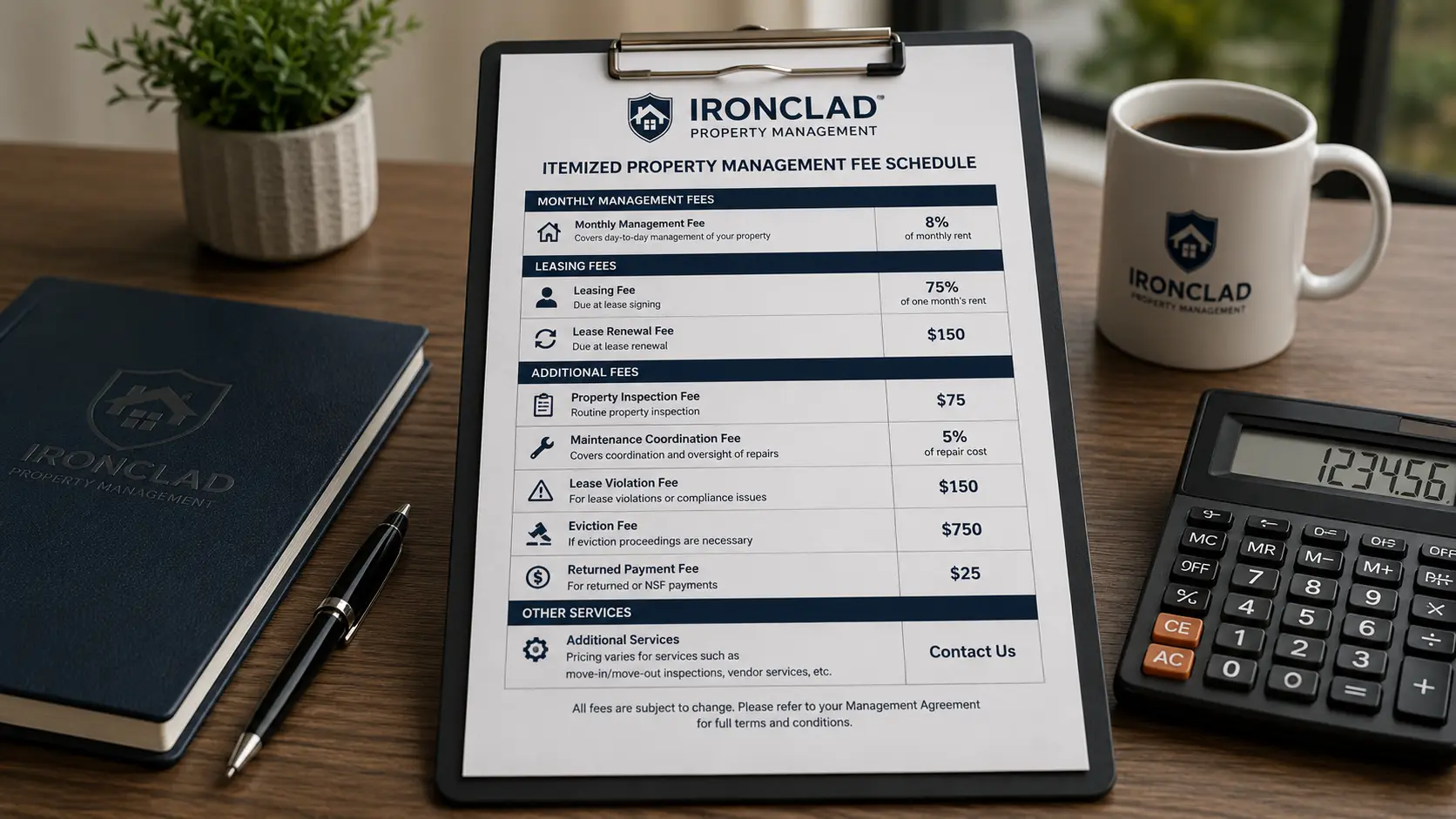
Leasing / tenant-placement fee. When the manager finds and places a new tenant, they typically charge a one-time leasing fee. In Connecticut this commonly runs 50% to 100% of one month's rent. On a $1,800 unit, that's $900–$1,800. It covers marketing, showings, screening, and lease preparation.
Setup / onboarding fee. A one-time charge to bring your property into their system, usually$100–$300.
Lease-renewal fee. Many managers charge a smaller fee (often $150–$300, or a fraction of one month's rent) each time a tenant renews. It's far cheaper than a full leasing fee but still a real cost.
Maintenance markups. Some companies add a percentage on top of contractor invoices for coordinating repairs. Ask whether they mark up maintenance and by how much.
Inspection fees. Proactive interior/exterior inspections can run$100–$200 per visit if billed separately rather than bundled.
Vacancy, marketing, and early-termination fees. Less common but worth asking about - some charge a reduced fee while a unit sits empty, an extra marketing fee, or a penalty if you cancel the contract early.
What's typically included in the monthly fee
Before you judge any percentage, understand what it's supposed to buy. A full-service monthly management fee in Connecticut generally covers:
Rent collection and owner disbursement- chasing payments, posting them, and getting your money to you on schedule.
Tenant communication and maintenance coordination- fielding tenant requests, dispatching vetted vendors, and handling emergencies.
Routine accounting and statements- monthly owner statements and year-end documents for taxes.
Lease enforcement and compliance- keeping the tenancy aligned with Connecticut landlord-tenant law, handling notices, and managing renewals.
Owner support- being your single point of contact so you're not the one taking the 9 p.m. "the heat is out" call.
The reason two companies can both quote "10%" and deliver wildly different value is that one bundles all of the above while another strips it down and bills the extras separately. That's why the percentage alone tells you very little.
A real-world cost example
Say you own a single-family rental in Connecticut renting for $2,200/month and you sign with a full-service manager at 10% with a leasing fee of 75% of one month's rent and a $200 setup fee.
Year one with a new tenant placed:$200 setup + $1,650 leasing (75% of $2,200) + $2,640 in monthly fees (10% x $2,200 x 12) = about$4,490, or roughly 17% of your $26,400 gross annual rent.
A stable year two with the same tenant:just the $2,640 in monthly fees, plus perhaps a modest renewal fee - closer to 10–11% of gross rent.
That pattern - a higher first-year cost driven by placement, then a lower steady-state cost - is normal. It's also why turnover is the enemy of your returns: every new placement resets that leasing fee. A manager who screens well and keeps good tenants longer quietly saves you far more than a one-point difference in the monthly percentage.
What drives the price up or down
Several factors move your fee within these ranges:
Property type and size. Single-family homes, condos, and small multi-families each carry different workloads. Multiple units under one roof may earn a volume discount per door.
Condition and age. Connecticut's older housing stock can mean more maintenance coordination, which some managers price in.
Location. Local demand and the going rate among nearby companies influence pricing.
Service level. Full-service management (marketing, screening, rent collection, maintenance, accounting, compliance, inspections) costs more than a bare-bones "tenant placement only" package - but it also does far more.
How to compare companies the right way
Don't choose on the lowest percentage alone. Instead:
Ask for a complete, written fee schedule Every fee, in writing, before you sign.
Confirm what's bundled. Are inspections, renewals, and accounting included, or extra?
Check the leasing fee and how often it applies. High tenant turnover plus a 100%-of-rent leasing fee adds up fast.
Read the cancellation terms. Know how to exit and what it costs.
Weigh value, not just cost. Faster leasing, better screening, and compliance support protect your income and reduce risk.
If you're weighing whether management is worth it at all, it helps to understand the full scope of what a property manager actually does- the fee buys back your time and lowers your exposure to a costly bad tenant or legal misstep.
What Ironclad PM charges
We believe owners deserve to know their costs upfront, with no buried add-ons. Our transparent pricing lays out exactly what's included in our property management services- from marketing and screening through rent collection, maintenance coordination, inspections, and Connecticut compliance - so you can compare us on total value, not a misleading headline number.
Once you understand the real cost of management, the next questions owners often ask are about protecting the income that property generates from requiring tenant renters insurance to staying compliant with Connecticut's disclosure rules. Knowing your fees is step one; knowing your obligations is step two.
Frequently Asked Questions